sábado, 18 de abril de 2015

O Gossan

O Gossan


Gossan, segundo a definição original é o produto do intemperismo sobre sulfetos maciços de minérios econômicos. Um sulfeto maciço, por sua vez tem que ter mais de 50% do peso em sulfetos... Esta é a definição inicial, que está sendo abandonada. Hoje, a visão dos Geólogos de Exploração sobre os gossans evoluiu: gossans são produtos de intemperismo de rochas sulfetadas não necessariamente maciças e não necessariamente derivados de sulfetos economicamente interessantes. Eles são também chamados de chapéus de ferro (Francês). Em alguns casos são chamados de gossans os ironstones derivados do intemperismo sobre carbonatos ricos em ferro como a siderita.
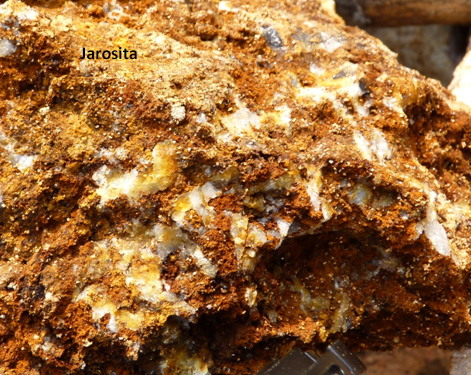
Os principais minerais de um gossan são a goethita e hematita. Outros hidróxidos de ferro comuns são geralmente agrupados como limonitas. Estes óxidos conferem à rocha a sua característica ferruginosa com cores fortes, ocre vermelho-amareladas. A rocha encontra-se na superfície podendo ou não estar em cima dos sulfetos originais. Gossans podem ser transportados. Neste caso os óxidos migraram e se precipitaram longe dos sulfetos de orígem.
Em geral um gossan é poroso e pulverulento. Seus minerais são formados pela decomposição dos sulfetos com formação de ácido sulfúrico. O ácido acelera sobremaneira a decomposição dos minerais, lixiviando parcial ou totalmente os elementos solúveis. A lixiviação pode ser tão intensa que os elementos solúveis como zinco ou até mesmo o cobre podem não mais estar presentes no gossan. Portanto a simples avaliação química de um deve levar em conta, também, aqueles elementos traços menos móveis que talvez estejam ainda presentes e que possam caracterizar a rocha como interessante. Esses estudos de fingerprinting são fundamentais quando o assunto é gossan.
Durante o processo de decomposição é comum que a textura original dos sulfetos se mantenha de uma forma reliquial: as chamadas boxwork textures. Texturas boxworks são entendidas por um pequeno e seleto grupo de geólogos. Elas indicam, em um grande número de casos, qual foi o sulfeto original. Em muitos gossans os boxworks só podem ser vistos ao microscópio petrográfico.
Foi essa correlação entre textura boxwork e o sulfeto original que gerou trabalhos clássicos sobre gossans, como o do pioneiro Ronald Blanchard ou o do colega Ross Andrew, possivelmente inexistentes nas bibliotecas das escolas de geologia. A determinação dos sulfetos a partir das texturas é uma arte que está sendo perdida nos nossos dias e tende a desaparecer com a chegada dos equipamentos de raio x portáteis.
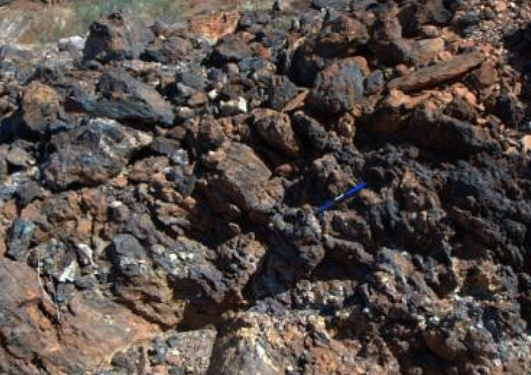
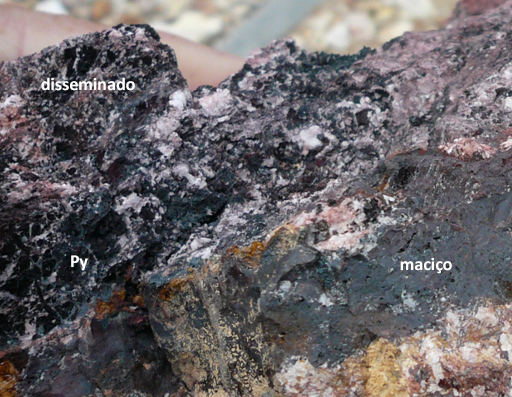
Gossan BlocksGossan piritaCarbonatoGold em gossanOpaline Gossan Calcopirita gossan 
Blocos de gossan
 calcopirita
Gossan sobre pirita
boxworks cúbicos
Pseudo gossan sobre carbonatosOuro em gossanGossan silicoso (opaline gossan)
Cu-Ni 
Gossan sobre calcopirita maciça
Foi através da descoberta de gossans na superfície que foram descobertas a maioria das jazidas de níquel sulfetado tipo Kambalda na Austrália na década de 60 e 70. Nesta época, a capacidade do Geólogo de distinguir entre gossans derivados de sulfetos de Cu-Ni dos derivados de sulfetos estéreis como a pirita e pirrotita foi o diferencial entre os bem sucedidos e os losers. Foi nesta época que se desenvolveu a microscopia de gossans pois, como dissemos acima, muitos gossans tiveram seus elementos econômicos lixiviados quase que totalmente restando somente o estudo de boxworks para a identificação dos sulfetos originais.
A determinação e estudo de gossans e de boxwork textures  levou à descoberta de inúmeros porphyry coppers como muitos dos gigantescos depósitos de Cu-Au-Mo dos Estados Unidos, Andes e mesmo na Ásia.
No Brasil é clássico o gossan de Igarapé Bahia, que foi lavrado por anos a céu aberto como um minério de ouro apenas...até a descoberta de calcopirita (Depósito Alemão) associada a magnetita, em profundidades de 100m. Se os Geólogos da Vale entendessem de gossans, naquela época, a descoberta do Alemão não seria feita por geofísica com décadas de atraso como foi o caso.
Mesmo descobertas como o depósito de Cobre de alto teor Mountain City em Nevada, 1919, foi uma decorrência de um estudo feito por um prospector de 68 anos chamado Hunt em um gossan tido como estéril. O gossan, que não tinha traços de cobre, jazia poucos metros acima de um rico manto de calcocita...O Hunt não sabia o que era um gossan mas acreditava que a rocha era um leached cap ou um produto de lixiviação de sulfetos. Ele tinha o feeling, coisa que todo o Geólogo de Exploração deve ter.  Exemplos como estes devem bastar para que você se convença da importância dos gossans na pesquisa mineral.
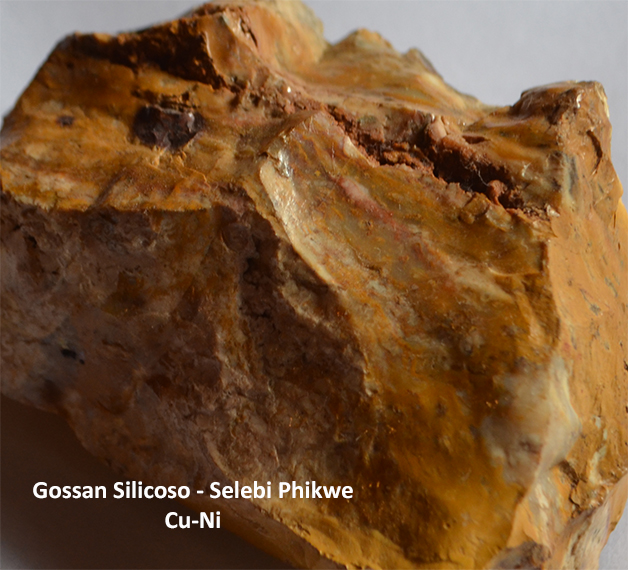
A foto do gossan silicoso é um excelente exemplo. Eu coletei essa amostra exatamente sobre um sulfeto maciço de Cu-Ni no Limpopo Belt em Botswana (Mina de Selebi Phikwee) minutos antes do gossan ser lavrado. O gossan estava 5 metros acima do sulfeto fresco...Neste caso o gossan é constituído quase que exclusivamente por sílica (calcedônia) de baixa densidade (devido aos poros microscópicos). Até o ferro foi remobilizado desta amostra. A cor amarelada da amostra se mesclava com cores avermelhadas no afloramento. Somente ao microscópio que aparecem os boxworks de calcopirita e de pirrotita e pentlandita. Selebi-Phikwe em produção desde 1966 deverá ser fechada ainda este ano.
Com certeza esse foi o último opaline gossan de Selebi-Phikwe. O mais interessante é que as análises que eu fiz no Brasil mostraram cobre abaixo de 100ppm e níquel em torno de 150ppm. Em outras palavras qualquer um que coletar uma amostra em ambiente ultramáfico que analise 70 ppm de Cu e 150ppm de Ni não vai soltar foguetes. Vai simplesmente desconsiderar a amostra e partir para outra. Ele poderá estar perdendo uma oportunidade extraordinária por desconhecer o que um gossan.
Se você ainda não está convencido da importância dos gossans entre no Google e pesquise duas palavras: gossan discovery. O Google vai listar milhares de papers sobre descobertas minerais feitas a partir de um afloramento de gossan.

LAMPROITE-HOSTED DIAMONDS

LAMPROITE-HOSTED DIAMONDS
by Jennifer Pell
Consulting Geologist
 
Ref: diamantes, lamproitos, xenocristais, manto, olivina lamproito, piroclásticas, brechas
 
Pell, J. (1998): Lamproite-hosted Diamonds, in Geological Fieldwork 1997, British Columbia Ministry of Employment and Investment, Paper 1998-1, pages 24M-1 to 24M-4.
IDENTIFICATION
SYNONYMS: None.
COMMODITY: Diamonds.
EXAMPLES (British Columbia (MINFILE #) - Canada/International): No B.C. examples; Argyle, Ellendale (Western Australia), Prairie Creek (Crater of Diamonds, Arkansas, USA), Bobi (Côte d'Ivoire), Kapamba (Zambia), Majhgawan (India).
GEOLOGICAL CHARACTERISTICS
CAPSULE DESCRIPTION: Diamonds occur as sparse xenocrysts and in mantle xenoliths within olivine lamproite pyroclastic rocks and dikes. Many deposits are found within funnel-shaped volcanic vents or craters. Lamproites are ultrapotassic mafic rocks characterized by the presence of olivine, leucite, richterite, diopside or sanidine.
TECTONIC SETTING: Most olivine lamproites are post-tectonic and occur close to the margins of Archean cratons, either within the craton or in adjacent accreted Proterozoic mobile belts.
DEPOSITIONAL ENVIRONMENT / GEOLOGICAL SETTING: Olivine lamproites are derived from metasomatized lithospheric mantle. They are generally emplaced in high-level, shallow "maar-type" craters crosscutting crustal rocks of all types.
AGE OF MINERALIZATION: Any age except Archean. Diamondiferous lamproites range from Proterozoic to Miocene in age.
HOST/ASSOCIATED ROCK TYPES: Olivine lamproite pyroclastic rocks and dikes commonly host mineralization while lava flows sampled to date are barren. Diamonds are rarely found in the magmatic equivalents. Lamproites are peralkaline and typically ultrapotassic (6 to 8% K2O). They are characterized by the presence of one or more of the following primary phenocryst and/or groundmass constituents: forsteritic olivine; Ti-rich, Al-poor phlogopite and tetraferriphlogopite; Fe-rich leucite; Ti, K-richterite; diopside; and Fe-rich sanidine. Minor and accessory phases include priderite, apatite, wadeite, perovskite, spinel, ilmenite, armalcolite, shcherbakovite and jeppeite. Glass and mantle derived xenocrysts of olivine, pyrope garnet and chromite may also be present.
DEPOSIT FORM: Most lamproites occur in craters which are irregular, asymmetric, and generally rather shallow (often the shape of a champagne glass), often less than 300 metres in depth. Crater diameters range from a few hundred metres to 1500 metres. Diamond concentrations vary between lamproite phases, and as such, ore zones will reflect the shape of the unit (can be pipes or funnel-shaped). The volcaniclastic rocks in many, but not all, lamproite craters are intruded by a magmatic phase that forms lava lakes or domes.
TEXTURE/STRUCTURE: Diamonds occur as discrete grains of xenocrystic origin that are sparsely and randomly distributed in the matrix of lamproites and some mantle xenoliths.
ORE MINERALOGY: Diamond.
GANGUE MINERALOGY (Principal and subordinate): Olivine, phlogopite, richterite, diopside, sanidine; priderite, wadeite, ilmenite, chromite, perovskite, spinel, apatite, pyrope garnet.
ALTERATION MINERALOGY: Alteration to talc carbonate sulphide or serpentine -septechlorite + magnetite has been described from Argyle (Jacques et al., 1986). According Scott Smith (1996), alteration to analcime, barite, quartz, zeolite, carbonate and other minerals may also occur. Diamonds can undergo graphitization or resorption.
WEATHERING: Clays, predominantly smectite, are the predominant weathering product of lamproites.
ORE CONTROLS: Lamproites are small-volume magmas which are confined to continental regions. There are relatively few lamproites known world wide, less than 20 geological provinces, of which only seven are diamondiferous. Only olivine lamproites are diamondiferous, other varieties, such as leucite lamproites presumably did not originate deep enough in the mantle to contain diamonds. Even within the olivine lamproites, few contain diamonds in economic concentrations. Controls on the differences in diamond content between intrusions are not completely understood. They may be due to: different depths of origin of the magmas (above or below the diamond stability field); differences in the diamond content of the mantle sampled by the lamproite magma; differences in degrees of resorption of diamonds during transport; or some combination of these factors.
GENETIC MODEL: Lamproites form from a small amount of partial melting in metasomatized lithospheric mantle at depths generally in excess of 150 km (i.e., within or beneath the diamond stability field). The magma ascends rapidly to the surface, entraining fragments of the mantle and crust en route. Diamonds do not crystallize from the lamproite magma. They are derived from harzburgitic peridotites and eclogites within regions of the sub-cratonic lithospheric mantle where the pressure, temperature and oxygen fugacity allow them to form in situ. If a lamproite magma passes through diamondiferous portions of the mantle, it may sample them and bring diamonds to the surface provided they are not resorbed during ascent.
ASSOCIATED DEPOSIT TYPES: Diamonds can be concentrated by weathering to produce residual concentrations or by erosion and transport to create placer deposits (C01, C02, C03). Kimberlite-hosted diamond deposits (N02) form in a similar manner, but the magmas may be of different origin.
EXPLORATION GUIDES
GEOCHEMICAL SIGNATURE: Lamproites can have associated Ni, Co, Ba and Nb anomalies in overlying residual soils. However, these may be restricted in extent since lamproites weather readily and commonly occur in depressions and dispersion is limited. Caution must be exercised as other alkaline rocks can give similar geochemical signatures.
GEOPHYSICAL SIGNATURE: Geophysical techniques are used to locate lamproites, but give no indication as to their diamond content. Ground and airborne magnetometer surveys are commonly used; weathered or crater-facies lamproites commonly form negative magnetic anomalies or dipole anomalies. Some lamproites, however, have no magnetic contrast with surrounding rocks. Various electrical methods (EM, VLF, resistivity) in airborne or ground surveys are excellent tools for detecting lamproites, given the correct weathering environment and contrasts with country rocks. In general, clays, particularly smectite, produced during the weathering of lamproites are conductive; and hence, produce strong negative resistivity anomalies.
OTHER EXPLORATION GUIDES: Heavy indicator minerals are used in the search for diamondiferous lamproites, although they are usually not as abundant as with kimberlites. Commonly, chromite is the most useful heavy indicator because it is the most common species and has distinctive chemistry. To a lesser extent, diamond, pyrope and eclogitic garnet, chrome spinel, Ti-rich phlogopite, K-Ti-richterite, low-Al diopside, forsterite and perovskite can be used as lamproite indicator minerals. Priderite, wadeite and shcherbakovite are also highly diagnostic of lamproites, although very rare.
ECONOMIC FACTORS
TYPICAL GRADE AND TONNAGE: When assessing diamond deposits, grade, tonnage and the average value ($/carat) of the diamonds must be considered. Diamonds, unlike commodities such as gold, do not have a set value. They can be worth from a few to thousands of $/carat depending on their quality (evaluated on the size, colour and clarity of the stone). Argyle is currently the only major lamproite-hosted diamond mine. It contains at least 75 million tonnes, grading between 6 and 7 carats of diamonds per tonne (1.2 to 1.4 grams/tonne). The Prairie Creek mine produced approximately 100 000 carats and graded 0.13 c/t. Typical reported grades for diamond-bearing lamproites of <0.01 to .3 carats per tonne are not economic (Kjarsgaard, 1995). The average value of the diamonds at Argyle is approximately $US 7/carat; therefore, the average value of a tonne of ore is approximately $US 45.50 and the value of total reserves in the ground is in excess of $US 3.4 billion.
END USES: Gemstones; industrial uses such as abrasives.
IMPORTANCE: Olivine lamproites have only been recognized as diamond host rocks for approximately the last 20 years as they were previously classified as kimberlites based solely on the presence of diamonds. Most diamonds are still produced from kimberlites; however, the Argyle pipe produces more carats per annum (approximately 38,000 in 1995), by far, than any other single primary diamond source. Approximately 5% of the diamonds are good quality gemstones.

Gahcho Kué a maior e mais rica mina de diamantes ainda não desenvolvida do mundo

Gahcho Kué a maior e mais rica mina de diamantes ainda não desenvolvida do mundo 


A junior canadense  Mountain Province está em JV com a De Beers (51%) para desenvolver o que é considerado o maior e mais rico jazimento de diamantes ainda não lavrado do mundo: o Projeto Gahcho Kué.

O projeto já teve um estudo de viabilidade econômica  que mostra um NPV 10% de 1 bilhão de dólares canadenses para uma mina de 12 anos. Segundo esse estudo a mina produzirá 53,4 milhões de quilates ao longo de sua vida útil: uma produção média de 4,45 milhões de quilates ao ano. Os estudos de grande volume indicam que o diamante de Gahcho Kué tem um valor médio de US$150/ quilate.

O que faz Gahcho Kué se destacar das demais jazidas é o seu altíssimo teor médio de 1,57 quilates por tonelada. A mina será uma operação a céu aberto sobre um dos quatro pipes que compõem o Kennady Lake kimberlite cluster (imagem ao lado). Os pipes são pequenos e, pelo menos um é um hipoabissal de pequeno volume que será lavrado somente no final da operação. Os outros dois pipes não apresentaram teores econômicos. A operação deverá dividir e drenar a água da parte sul do Lago Kennady que cobre o kimberlito mineralizado.

As empresas esperam entrar em produção em 2016.

KIMBERLITE-HOSTED DIAMONDS

KIMBERLITE-HOSTED DIAMONDS
by Jennifer Pell
Consulting Geologist
 
Ref: kimberlito, diamante, brecha, tufos, xenocristais, indicadores, olivina, ilmenita, piropo, espinélio, eclogito, granada, manto
 
Pell, J. (1998): Kimberlite-hosted Diamonds, in Geological Fieldwork 1997, British Columbia Ministry of Employment and Investment, Paper 1998-1, pages 24L-1 to 24L-4.
IDENTIFICATION
SYNONYMS: Diamond-bearing kimberlite pipes, diamond pipes, group 1 kimberlites.
COMMODITIES (BYPRODUCTS): Diamonds (some gemstones produced in Russia from pyrope garnets and olivine).
EXAMPLES (British Columbia - Canada/International): No B.C. deposits, see comments below for prospects; Koala, Panda, Sable, Fox and Misery (Northwest Territories, Canada), Mir, International, Udachnaya, Aikhal and Yubilenaya (Sakha, Russia), Kimberly, Premier and Venetia (South Africa), Orapa and Jwaneng (Botswana), River Ranch (Zimbabwe).
GEOLOGICAL CHARACTERISTICS
CAPSULE DESCRIPTION: Diamonds in kimberlites occur as sparse xenocrysts and within diamondiferous xenoliths hosted by intrusives emplaced as subvertical pipes or resedimented volcaniclastic and pyroclastic rocks deposited in craters. Kimberlites are volatile-rich, potassic ultrabasic rocks with macrocrysts (and sometimes megacrysts and xenoliths) set in a fine grained matrix. Economic concentrations of diamonds occur in approximately 1% of the kimberlites throughout the world.
TECTONIC SETTING: Predominantly regions underlain by stable Archean cratons.
DEPOSITIONAL ENVIRONMENT / GEOLOGICAL SETTING: The kimberlites rise quickly from the mantle and are emplaced as multi-stage, high-level diatremes, tuff-cones and rings, hypabyssal dikes and sills.
AGE OF MINERALIZATION: Any age except Archean for host intrusions. Economic deposits occur in kimberlites from Proterozoic to Tertiary in age. The diamonds vary from early Archean to as young as 990 Ma.
HOST/ASSOCIATED ROCK TYPES: The kimberlite host rocks are small hypabyssal intrusions which grade upwards into diatreme breccias near surface and pyroclastic rocks in the crater facies at surface. Kimberlites are volatile-rich, potassic ultrabasic rocks that commonly exhibit a distinctive inequigranular texture resulting from the presence of macrocrysts (and sometimes megacrysts and xenoliths) set in a fine grained matrix. The megacryst and macrocryst assemblage in kimberlites includes anhedral crystals of olivine, magnesian ilmenite, pyrope garnet, phlogopite, Ti-poor chromite, diopside and enstatite. Some of these phases may be xenocrystic in origin. Matrix minerals include microphenocrysts of olivine and one or more of: monticellite, perovskite, spinel, phlogopite, apatite, and primary carbonate and serpentine. Kimberlites crosscut all types of rocks.
DEPOSIT FORM: Kimberlites commonly occur in steep-sided, downward tapering, cone-shaped diatremes which may have complex root zones with multiple dikes and "blows". Diatreme contacts are sharp. Surface exposures of diamond-bearing pipes range from less than 2 up to 146 hectares (Mwadui). In some diatremes the associated crater and tuff ring may be preserved. Kimberlite craters and tuff cones may also form without associated diatremes (e.g. Saskatchewan); the bedded units can be shallowly-dipping. Hypabyssal kimberlites commonly form dikes and sills.
TEXTURE/STRUCTURE: Diamonds occur as discrete grains of xenocrystic origin and tend to be randomly distributed within kimberlite diatremes. In complex root zones and multiphase intrusions, each phase is characterized by unique diamond content (e.g. Wesselton, South Africa). Some crater-facies kimberlites are enriched in diamonds relative to their associated diatreme (e.g. Mwadui, Tanzania) due to winnowing of fines. Kimberlite dikes may display a dominant linear trend which is parallel to joints, dikes or other structures.
ORE MINERALOGY: Diamond.
GANGUE MINERALOGY (Principal and subordinate): Olivine, phlogopite, pyrope and eclogitic garnet, chrome diopside, magnesian ilmenite, enstatite, chromite, carbonate, serpentine; monticellite, perovskite, spinel, apatite. Magma contaminated by crustal xenoliths can crystallize minerals that are atypical of kimberlites.
ALTERATION MINERALOGY: Serpentinization in many deposits; silicification or bleaching along contacts. Secondary calcite, quartz and zeolites can occur on fractures. Diamonds can undergo graphitization or resorption.
WEATHERING: In tropical climates, kimberlite weathers quite readily and deeply to "yellowground" which is predominantly comprised of clays. In temperate climates, weathering is less pronounced, but clays are still the predominant weathering product. Diatreme and crater facies tend to form topographic depressions while hypabyssal dikes may be more resistant.
ORE CONTROLS: Kimberlites typically occur in fields comprising up to 100 individual intrusions which often group in clusters. Each field can exhibit considerable diversity with respect to the petrology, mineralogy, mantle xenolith and diamond content of individual kimberlites. Economically diamondiferous and barren kimberlites can occur in close proximity. Controls on the differences in diamond content between kimberlites are not completely understood. They may be due to: depths of origin of the kimberlite magmas (above or below the diamond stability field); differences in the diamond content of the mantle sampled by the kimberlitic magma; degree of resorption of diamonds during transport; flow differentiation, batch mixing or, some combination of these factors.
GENETIC MODEL: Kimberlites form from a small amount of partial melting in the asthenospheric mantle at depths generally in excess of 150 km. The magma ascends rapidly to the surface, entraining fragments of the mantle and crust, en route. Macroscopic diamonds do not crystallize from the kimberlitic magma. They are derived from harzburgitic peridotites and eclogites within regions of the sub-cratonic lithospheric mantle where the pressure, temperature and oxygen fugacity allow them to form. If a kimberlite magma passes through diamondiferous portions of the mantle, it may sample and bring diamonds to the surface provided they are not resorbed during ascent. The rapid degassing of carbon dioxide from the magma near surface produce fluidized intrusive breccias (diatremes) and explosive volcanic eruptions.
ASSOCIATED DEPOSIT TYPES: Diamonds can be concentrated by weathering to produce residual concentrations or within placer deposits (C01, C02, C03). Lamproite-hosted diamond deposits (N03) form in a similar manner, but the magmas may be of different origin.
COMMENTS: In British Columbia the Cross kimberlite diatreme and adjacent Ram diatremes (MINFILE # - 082JSE019) are found near Elkford, east of the Rocky Mountain Trench. Several daimond fragments and one diamond are reported from the Ram pipes.
EXPLORATION GUIDES
GEOCHEMICAL SIGNATURE: Kimberlites commonly have high Ti, Cr, Ni, Mg, Ba and Nb values in overlying residual soils. However, caution must be exercised as other alkaline rocks can give similar geochemical signatures. Mineral chemistry is used extensively to help determine whether the kimberlite source is diamondiferous or barren (see other exploration guides). Diamond-bearing kimberlites can contain high-Cr, low-Ca pyrope garnets (G10 garnets), sodium-enriched eclogitic garnets, high chrome chromites with moderate to high Mg contents and magnesian ilmenites.
GEOPHYSICAL SIGNATURE: Geophysical techniques are used to locate kimberlites, but give no indication as to their diamond content. Ground and airborne magnetometer surveys are commonly used; kimberlites can show as either magnetic highs or lows. In equatorial regions the anomalies are characterized by a magnetic dipolar signature in contrast to the "bulls-eye" pattern in higher latitudes. Some kimberlites, however, have no magnetic contrast with surrounding rocks. Some pipes can be detected using electrical methods (EM, VLF, resistivity) in airborne or ground surveys. These techniques are particularly useful where the weathered, clay-rich, upper portions of pipes are developed and preserved since they are conductive and may contrast sufficiently with the host rocks to be detected. Ground based gravity surveys can be useful in detecting kimberlites that have no other geophysical signature and in delineating pipes. Deeply weathered kimberlites or those with a thick sequence of crater sediments generally give negative responses and where fresh kimberlite is found at surface, a positive gravity anomaly may be obtained.
OTHER EXPLORATION GUIDES: Indicator minerals are used extensively in the search for kimberlites and are one of the most important tools, other than bulk sampling, to assess the diamond content of a particular pipe. Pyrope and eclogitic garnet, chrome diopside, picroilmenite, chromite and, to a lesser extent, olivine in surficial materials (tills, stream sediments, loam, etc.) indicate a kimberlitic source. Diamonds are also usually indicative of a kimberlitic or lamproitic source; however, due to their extremely low concentration in the source, they are rarely encountered in surficial sediments. Weathered kimberlite produces a local variation in soil type that can be reflected in vegetation.
ECONOMIC FACTORS
TYPICAL GRADE AND TONNAGE: When assessing diamond deposits, grade, tonnage and the average value ($/carat) of the diamonds must be considered.. Diamonds, unlike commodities such as gold, do not have a set value. They can be worth from a few $/carat to thousands of $/carat depending on their quality (evaluated on the size, colour and clarity of the stone). Also, the diamond business is very secretive and it is often difficult to acquire accurate data on producing mines. Some deposits have higher grades at surface due to residual concentration. Some estimates for African producers is as follows:
PipeTonnage (Mt)Grade (carats*/100 tonne)
Orapa117.868
Jwaneng44.3140
Venetia66120
Premier33940
* one carat of diamonds weighs 0.2 grams
ECONOMIC LIMITATIONS: Most kimberlites are mined initially as open pit operations; therefore, stripping ratios are an important aspect of economic assessments. Serpentinized and altered kimberlites are more friable and easier to process.
END USES: Gemstones; industrial uses such as abrasives.
IMPORTANCE: In terms of number of producers and value of production, kimberlites are the most important primary source of diamonds. Synthetic diamonds have become increasingly important as alternate source for abrasives.

Aromatites

Aromatites
Fonte: CSIRO
spinifex texture in komatiite from Mt KeithKomatiites are a remarkable class of ultramafic (very magnesium-rich) lavas which are, with very few exceptions, restricted to the first half of the earth's history. A remarkable global outpouring of komatiites occurred around 2700 million years ago, and komatiites of this age host a significant proportion of the world's sulfide nickel resources.
Komatiites were exeptionally hot. The most extreme examples probably erupted at temperatures in excess of 1600 degrees C. At this temperature, the lavas would have been extremely fluid, with viscosities approaching that of water. However, our research leads us to believe that they were erupted by much the same mechanisms that govern modern basalt lava flows.
Nickel sulfide deposits in komatiites occur largely within linear, olivine-choked lava pathways which may originally have formed as lava tubes, within regionally extensive flow fields (see diagram below). The origin of these deposits remains controversial, but several lines of evidence strongly favour a hypothesis referred to variously as "ground melting", "thermal erosion" or "substrate erosion". According to this hypothesis, komatiite lavas melted and eroded the ground they flowed over, causing the lavas to become contaminated by this molten substrate. Where the substrate contained high proportions of sulfur, this caused an immiscible suflide melt to form, in the same way a molten sulfide matte forms in a blast furnace, with the komatiite lava being analogous to the slag. The immiscible sulfide melt scavenged Ni, Cu and platinum group metals from the silicate melt, forming an "ore magma". Orebodies formed where this ore magma pooled and froze at the floor of the flowing lava. The erosion process, and the accumulation of sulfide ores, are restricted to the major flow pathways within the lava flow lobe, as illustrated
Figure 1. Schematic diagram illustrating the genesis of sulphide ores in komatiite lava-flows.
The Ni-Cu-PGE Group (formerly known as the Magmatic Ore Deposits Group) has carried out an extended program of research on the characteristics and origin of these deposits, which include some of the world's most important Ni resources (see below). Our main lines of enquiry have been:
The volcanology of komatiites - how were they erupted, and under what conditions could they erode their substrates? Can this knowledge be used to guide exploration in metamorphosed and deformed terrains?
Lithogeochemical indicators - can chemical indicators of mineralising processes be detected in komatiite suites, and if so, can they be used to prioritise exploration targets?